 Maldives Compass
Where Is the Maldives?
Pinpoint its location in the Indian Ocean and understand the geography of the atoll chain.
A country, an archipelago, and one of the most distinctive nations on the planet.
The Republic of Maldives is a sovereign country in South Asia, officially known in Dhivehi as Dhivehi Raajjeyge Jumhooriyyaa. It is composed of approximately 1,200 coral islands grouped into 26 natural atolls, which together form a chain stretching about 870 kilometres from north to south in the Indian Ocean. Despite covering a vast area of ocean, the total land area of the Maldives is only around 300 square kilometres - roughly the size of a small city.
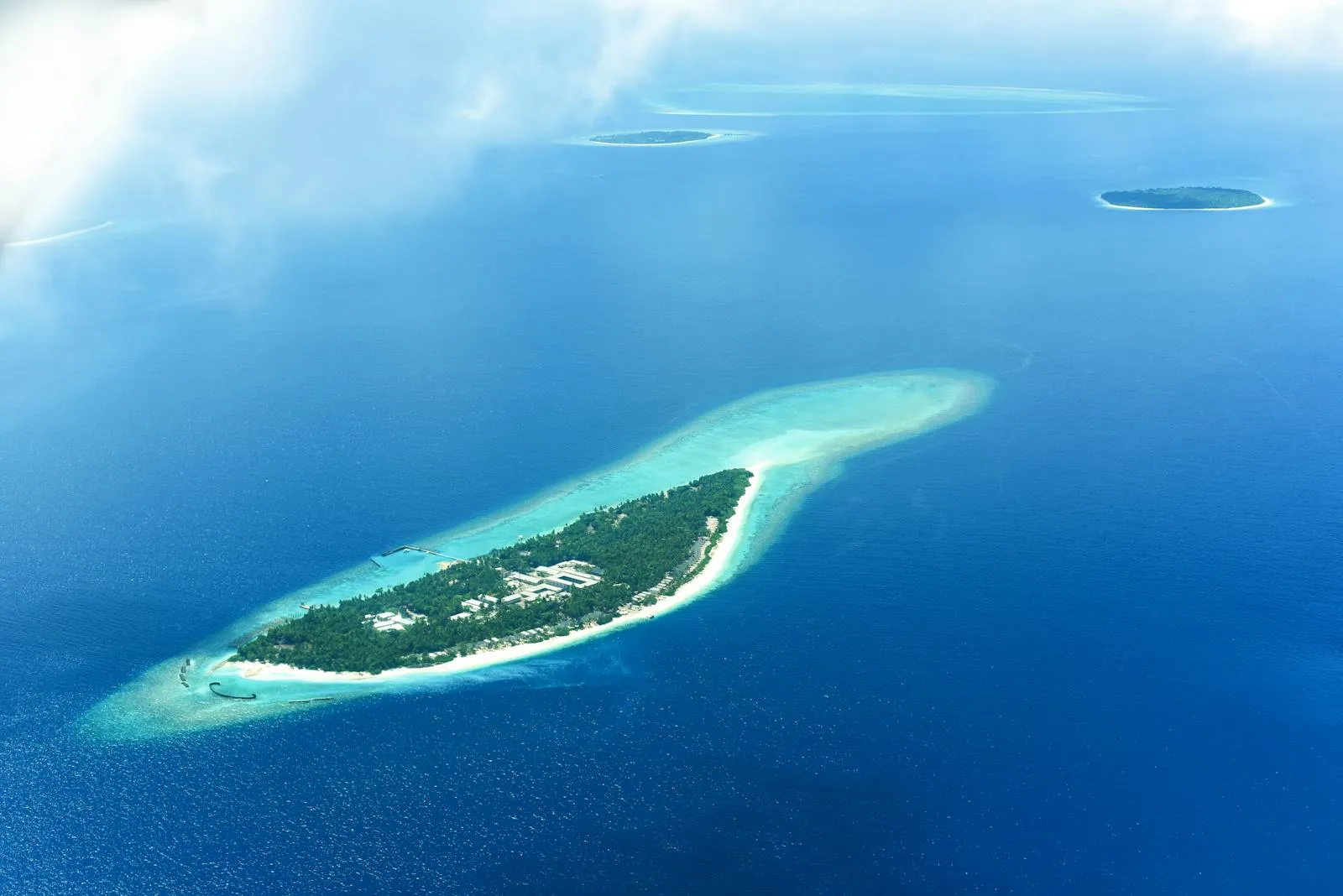
Of those 1,200 islands, only about 200 are inhabited by local Maldivian communities. More than 150 operate as tourist resort islands, each typically occupied by a single resort. The rest remain uninhabited - many are tiny sandbanks or patches of vegetation that shift with the tides and seasons.
The word "atoll" itself comes from the Dhivehi word atholhu, which gives you a sense of how central these ring-shaped coral formations are to Maldivian identity. Each atoll is a roughly circular or oval ring of coral reef enclosing a shallow lagoon. Within that ring sit the individual islands - some no larger than a football pitch, others spanning a few square kilometres.
For administrative purposes, the 26 natural atolls are divided into 20 administrative divisions, each identified by a letter of the Thaana script. The coral reefs that form these atolls are living ecosystems, built over thousands of years by tiny coral polyps. This means the entire country is, in a very real sense, built on biology rather than geology.
The capital city, Malé, sits on a small island of just over five square kilometres in the Kaafu Atoll. Despite its tiny footprint, Malé is home to well over 200,000 people, making it one of the most densely populated cities in the world. It serves as the administrative, commercial, and cultural heart of the nation. The international airport, Velana International, is located on a neighbouring artificial island called Hulhulé.
Beyond Malé, the second-largest urban centre is Addu City in the far south, which consists of several islands connected by causeways. Other notable population centres include Fuvahmulah, a single-island city that sits outside any traditional atoll formation, and Kulhudhuffushi in the north.
The Maldives has a population of over half a million citizens. Maldivians are ethnically diverse, with historical roots connecting them to South Asia, Southeast Asia, East Africa, and the Arab world - a reflection of centuries of maritime trade and migration. The official language is Dhivehi, a member of the Indo-Aryan language family written in the Thaana script, which reads from right to left. Islam is the state religion, and the Maldives has been a Muslim-majority nation since the 12th century.
Tourism is the largest sector of the Maldivian economy, accounting for a significant share of GDP and government revenue. The country welcomed the concept of island tourism in 1972, and the industry has grown steadily since. Fishing - particularly tuna fishing - remains culturally and economically important, and the Maldives is known for its sustainable pole-and-line fishing methods. You can learn more about this culinary tradition in the food section.
The Maldives holds several notable distinctions. It is the lowest-lying country on Earth, with an average ground level of about 1.5 metres above sea level, and no natural point rises higher than about 2.4 metres. It is also Asia's smallest country by both land area and population. These facts shape not only the country's geography but its politics and future, as rising sea levels pose an existential challenge to the nation.