 Maldives Compass
The Engineering Behind the Stilts
An overwater villa might look like a simple wooden hut perched above the sea, but the engineering required to build one is considerable. Each villa rests on a grid of steel or reinforced concrete pilings driven deep into the seabed. In the Maldives, the lagoon floors are typically composed of compacted coral sand, which provides a reasonably stable foundation, but the pilings must still extend several metres below the sand to reach firmer substrate and resist the lateral forces of waves and currents.
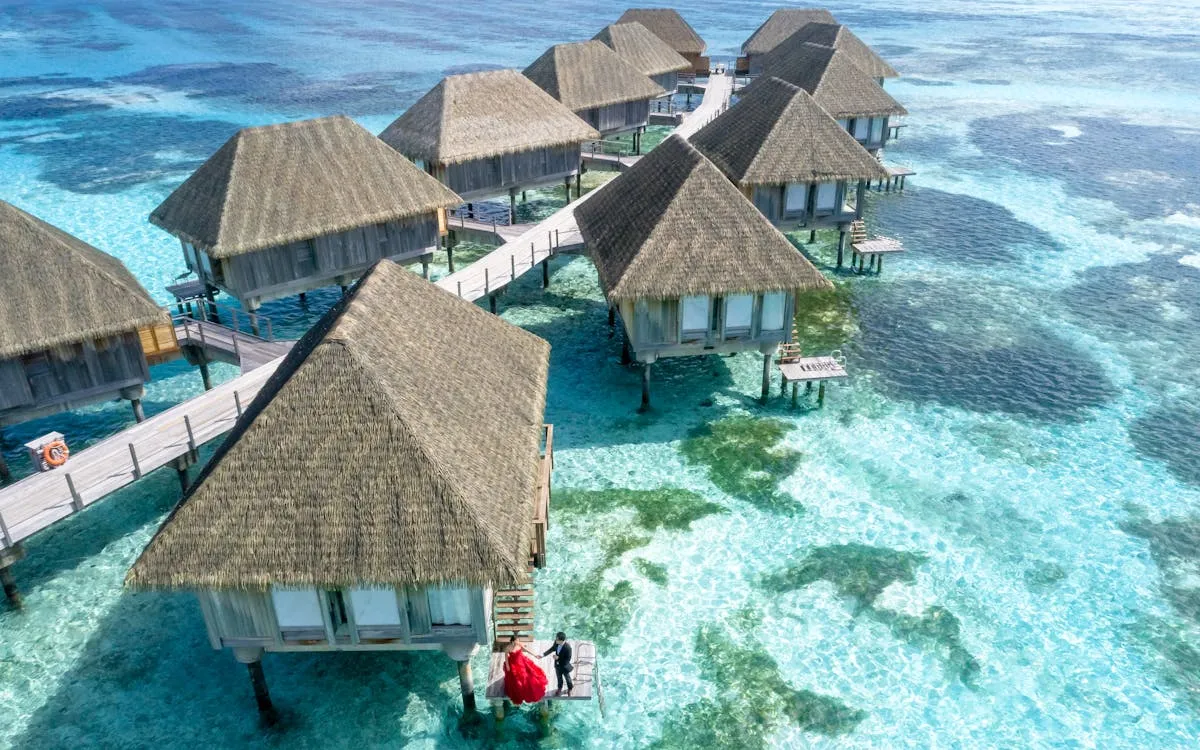
The number of pilings varies depending on the size of the villa. A modest overwater bungalow might rest on eight to twelve pilings, while a large luxury water villa with a private pool and extended sun deck can require twenty or more. The pilings are typically driven using small barge-mounted pile drivers, and the work must be done carefully to minimise damage to the surrounding reef and seabed. Once the pilings are in place, a steel or timber frame is constructed on top, followed by the floor, walls, and roof. The entire structure must be engineered to withstand tropical storms, salt corrosion, and the constant motion of the sea beneath.
Glass Floors and Direct Water Access
Two features have become almost standard in modern overwater villas: glass floor panels and private stairs or ladders leading directly into the water. The glass floor sections are typically installed in the living room or bedroom, giving guests a window into the lagoon below. These panels are made from thick, laminated safety glass that can support significant weight while remaining transparent. On a calm day with clear water, you can watch reef fish, small rays, and occasionally even juvenile sharks swimming beneath your feet.
The private water access is one of the defining attractions of the overwater villa experience. Most villas include a set of stairs or a ladder descending from the sun deck directly into the lagoon. The water depth at the base of the stairs is usually between one and three metres, depending on the tide and the location of the villa. Some resorts position their villas over deeper water near the reef edge, while others keep them in the shallower parts of the lagoon. This direct access means guests can snorkel, swim, or simply wade into the water at any time of day without having to walk to a beach.
A Brief History of Overwater Accommodation
The concept of overwater accommodation did not originate in the Maldives. The first overwater bungalows were built in Tahiti in French Polynesia in the late 1960s, created by a group of American entrepreneurs who wanted to offer tourists the experience of sleeping above a tropical lagoon. The idea proved enormously popular and spread across the South Pacific during the 1970s.
The Maldives adopted the concept in the 1980s as the country's resort tourism industry was expanding rapidly. The shallow, calm lagoons of the Maldivian atolls proved ideal for overwater construction, and the format fit perfectly with the one-island-one-resort model that was already becoming the standard. Early Maldivian overwater rooms were relatively simple structures, but by the 2000s and 2010s, they had evolved into sprawling luxury suites with private pools, outdoor showers, butler service, and underwater bedrooms. Today, the Maldives is home to more overwater villas than any other country in the world, and the format has become synonymous with the destination.
Sustainability Considerations
Building over water presents real environmental challenges. The construction process can disturb the seabed and damage coral if not managed carefully. Pilings driven too close to living reef can kill coral colonies, and the shading effect of the villa structures above reduces the sunlight reaching the lagoon floor, which can affect seagrass beds and coral growth beneath the villas.
Modern resorts have adopted several measures to mitigate these impacts. Environmental impact assessments are now required before construction, and most reputable resorts position their villas over sandy areas rather than living reef. Waste water from the villas is treated before being discharged, and many resorts now use desalinated seawater rather than drawing from the island's limited freshwater lens. Some properties have gone further, installing coral nurseries near their overwater villas to offset any reef damage caused during construction. Solar panels on villa roofs are increasingly common, and a number of resorts have committed to carbon-neutral operations.
What Staying in One Is Actually Like
The reality of staying in an overwater villa is a sensory experience that photographs and videos cannot fully convey. The most immediate sensation is the sound. The gentle lapping of water beneath the floor is a constant, soft background rhythm that is especially noticeable at night. Many guests find it deeply relaxing, though some find it takes a night to adjust to the subtle motion and sound.
Privacy is another defining feature. Because the villas extend out from the island on jetties, often with considerable spacing between them, guests have an unusual degree of seclusion. Your nearest neighbours might be thirty or forty metres away, separated by open water. The sun deck feels like your own private pier, and the view is typically unobstructed ocean or lagoon in at least two directions.
Practical considerations include the walk. Overwater villas are connected to the island by long wooden jetties, and some villas at the far end of a row can be a five to ten minute walk from the main facilities. Many resorts provide bicycles or buggies to manage this. The villas themselves are fully air-conditioned and equipped with modern amenities, but the tropical marine environment means that salt air and humidity are constant companions. Resorts invest heavily in maintenance to keep the timber, metalwork, and fixtures in good condition against the corrosive effects of the sea.