 Maldives Compass
Everyday Life in the Maldives
See how fishing fits into the daily routines and community bonds of island life.
For centuries, the ocean has provided everything - food, livelihood, identity, and connection. In the Maldives, fishing is not just a profession; it is a way of life.
Long before the first tourist resort opened in 1972, the Maldives was a fishing nation. For most of its history, the economy and daily survival of island communities depended on what could be pulled from the sea. Tuna - particularly skipjack tuna - has been the cornerstone of this relationship, providing food for local consumption and, in its dried and smoked form (Maldive fish or hikimas), a valuable export commodity that has been traded across the Indian Ocean for centuries.
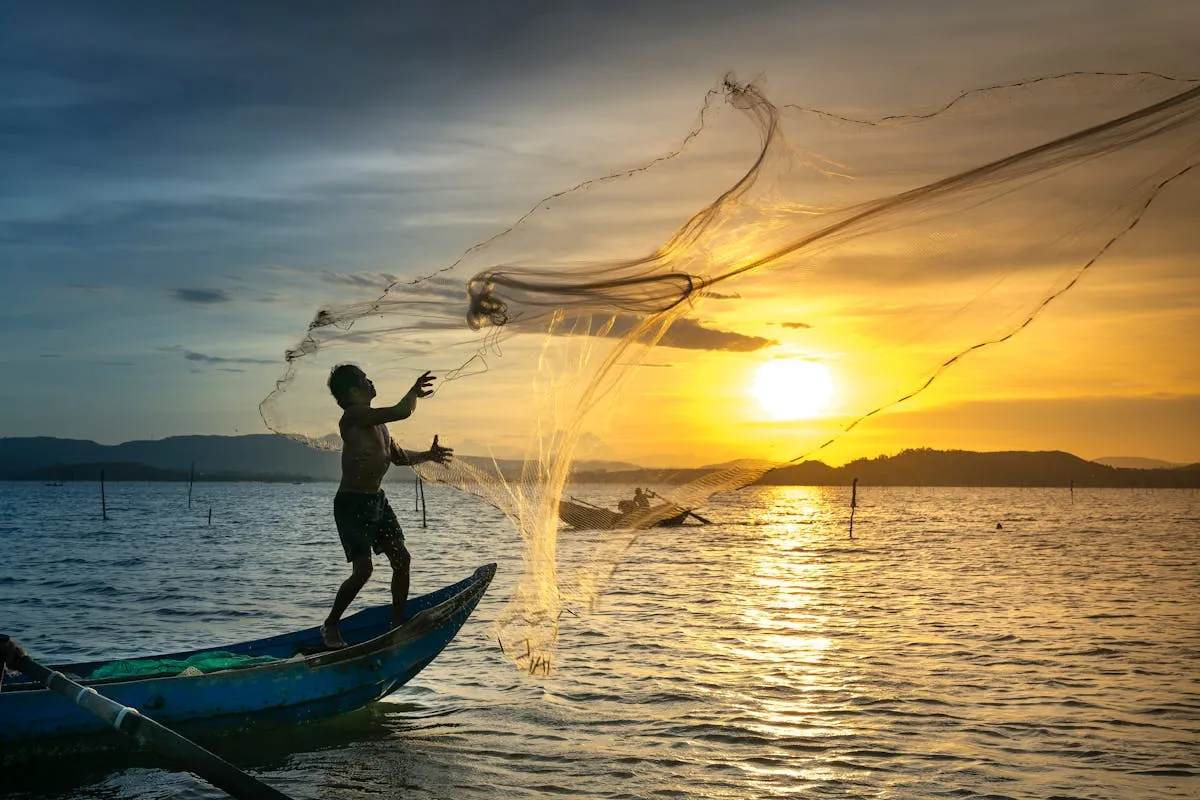
Even today, with tourism dominating the national economy, fishing remains the second-largest industry and by far the most culturally significant. On many outer-atoll local islands, fishing is still the primary livelihood, and the rhythms of the fishing day shape the entire community's schedule.
The Maldives is internationally recognised for its traditional pole-and-line tuna fishing method - a technique that is both time-honoured and remarkably sustainable. Unlike the industrial purse-seine nets used by many fishing fleets worldwide, pole-and-line fishing catches tuna one fish at a time, virtually eliminating bycatch (the accidental capture of other marine species).
The process begins with locating a school of tuna, often guided by the presence of seabirds or the knowledge passed down through generations about where fish gather at different times of year and tide. Once a school is found, the crew throws live bait fish into the water to create a feeding frenzy. As the tuna swarm to the surface, fishermen standing along the gunwale of the boat use barbless hooks on short poles to flick the fish aboard in a fast, continuous motion.
Watching a pole-and-line crew in action is impressive - the speed, coordination, and physical stamina required are impressive. Fish fly through the air in rapid succession, and a skilled crew can land hundreds of tuna in a matter of minutes during a productive session. The barbless hooks mean each fish is released from the line almost instantly, allowing the fisherman to cast again without pause.
No discussion of Maldivian fishing - or Maldivian life in general - is complete without the dhoni. The dhoni is the traditional boat of the Maldives, and its distinctive curved prow is practically a national symbol. Dhonis have been built in the Maldives for centuries, traditionally from coconut palm wood, though modern versions use fibreglass and marine plywood.
The design of the dhoni evolved to suit local conditions - the shallow lagoons within atolls, the deeper channels between them, and the open ocean beyond. Different sizes and types serve different purposes: smaller dhonis for reef fishing and inter-island transport, larger ones (known as mas dhoni) for deep-sea tuna fishing, and the biggest (bokkuraa and cargo dhonis) for transporting goods between atolls.
Dhoni building was traditionally a skilled craft practised in specific boat-building communities. The master builder - the maavadi - held a respected position in island society. While mechanised boats and fibreglass hulls have largely replaced traditional construction methods, the dhoni form endures, and you will see these graceful vessels everywhere in the Maldives, from fishing harbours to resort transfer fleets.
The relationship between Maldivians and their catch does not end at the harbour. Traditionally, much of the tuna caught was processed into Maldive fish - smoked, dried, and hardened into dark, wood-like pieces that could be stored for months without refrigeration. This preserved fish became the foundation of Maldivian cuisine, grated or shredded into countless dishes, and was the country's most important export for centuries.
The process of making Maldive fish involves boiling the tuna, smoking it over coconut husks, and then sun-drying it over several days. Historically, this was primarily women's work - while men fished at sea, women managed the processing on shore. The smell of smoking fish was once an everyday feature of island life, and on some islands it still is.
Maldive fish remains a staple ingredient in Maldivian cooking, appearing in garudhiya (fish broth), mas huni (the signature breakfast dish), curries, and snacks. It is also exported to Sri Lanka, where it is a key ingredient in many local dishes. You can explore these culinary traditions further in our food section.
The Maldives has earned a strong reputation for sustainable fishing practices. The pole-and-line method produces virtually no bycatch and does not damage the coral reef ecosystems that surround the islands. The Maldives has also banned net fishing within its waters and prohibited shark fishing, recognising the ecological and economic value of healthy marine ecosystems for both fisheries and tourism.
Maldivian tuna carries several international sustainability certifications, and the country has worked to market its fish as a premium, sustainably caught product. For a nation where the ocean is everything - the source of food, income, tourism revenue, and cultural identity - protecting marine resources is not an abstract environmental concern but an existential priority.
Climate change poses significant challenges, as rising ocean temperatures affect tuna migration patterns and coral reef health. Yet the fishing communities of the Maldives have adapted to changing seas for centuries, and that resilience remains a defining characteristic of island life.
Visitors can connect with Maldivian fishing culture in several ways. Many resort islands offer sunset fishing trips aboard dhonis, giving guests a taste of line fishing in the lagoon. On local islands, watching the fishing boats return in the morning and the catch being unloaded at the harbour is a vivid, everyday spectacle. Some guesthouses on local islands arrange trips with local fishermen, offering a more authentic experience.
Simply eating fresh fish in the Maldives - whether a grilled reef fish at a resort or a bowl of garudhiya in a local island tea shop - connects you to a fishing tradition that is centuries old and still very much alive.