 Maldives Compass
Seeing Bioluminescence
Practical guide to viewing the glow.
When the ocean glows electric blue at night, you are witnessing one of nature's most magical displays - and the Maldives is one of the best places on Earth to see it.
The glowing blue light that sometimes illuminates Maldivian beaches at night is caused by bioluminescent phytoplankton - microscopic organisms called dinoflagellates, primarily of the species Noctiluca scintillans (commonly known as sea sparkle). These tiny single-celled creatures produce light through a chemical reaction when they are disturbed by movement: waves washing onto shore, a fish swimming through the water, or your hand trailing through the surface.
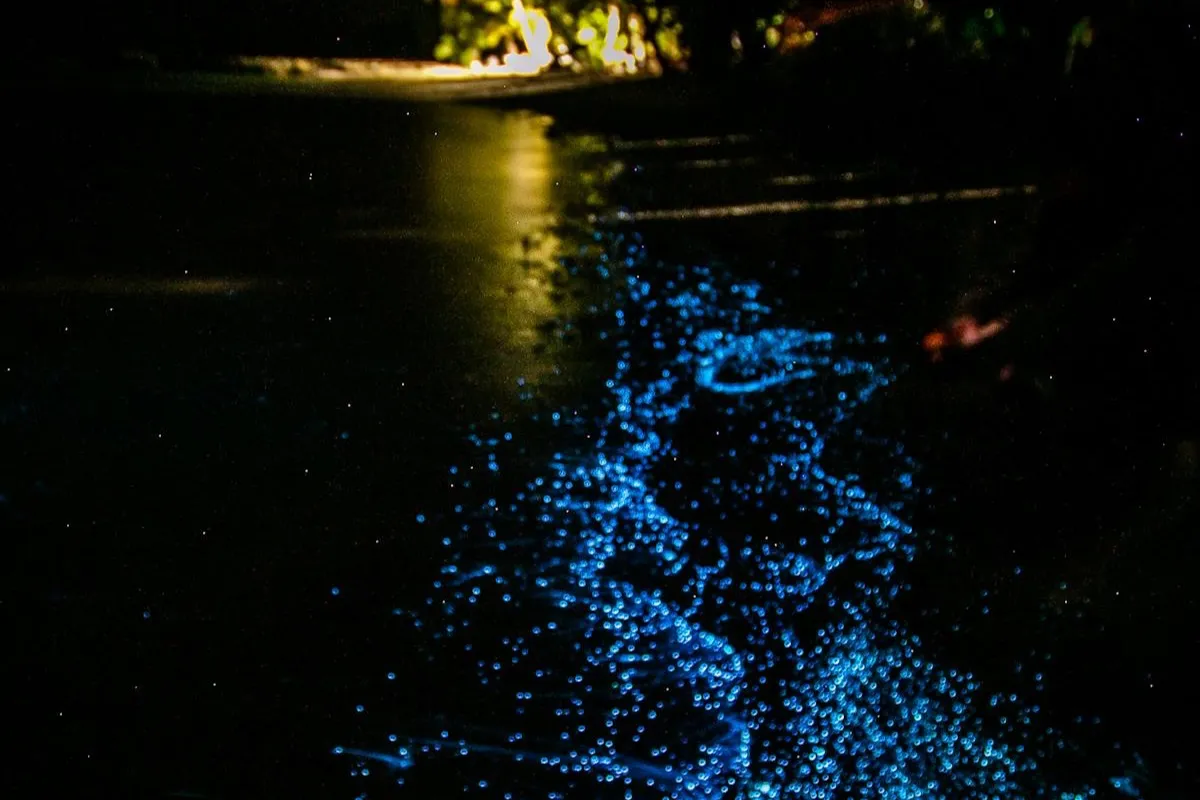
The light is produced by a molecule called luciferin, which reacts with oxygen in the presence of an enzyme called luciferase. The resulting glow is a defence mechanism - the flash of light startles predators or attracts larger predators that eat the organism's attackers. In the Maldives, when conditions are right and millions of these organisms accumulate along the shoreline, the effect is notable: each breaking wave leaves a trail of blue-white light, and footsteps in the wet sand create glowing impressions.
Bioluminescence can occur on any island in the Maldives, but it is more commonly reported on certain beaches and during certain conditions. Islands with gently sloping beaches and sheltered lagoons tend to accumulate plankton more readily. Some locations frequently mentioned by travellers and locals include:
It is important to understand that bioluminescence is a natural phenomenon that cannot be guaranteed. You might visit a famous bioluminescence beach and see nothing, or walk along an unremarkable shore on a random island and find it glowing. The conditions need to align.
Bioluminescence in the Maldives is most frequently observed during the southwest monsoon season, roughly from June to October, and particularly during the monsoon transition months. Several factors increase your chances:
If you are lucky enough to encounter bioluminescence, here are some ways to make the most of it:
Photographing bioluminescence is challenging but possible with the right equipment. You need a camera capable of long exposures (most modern smartphones struggle in these conditions). Use a tripod, set a long exposure of 15 to 30 seconds, a wide aperture (f/2.8 or wider), and a high ISO (1600 to 6400). The glow photographs as a blue or cyan colour, often more vivid in images than it appears to the naked eye. Resist the temptation to use a flashlight or phone screen near the beach - artificial light ruins both the view and the photograph.
Noctiluca scintillans is not a plant or an animal but a protist - a single-celled organism that shares characteristics with both. It feeds on other plankton, algae, and detritus, and it reproduces rapidly when conditions are favourable, creating the dense blooms that produce visible bioluminescence. While beautiful, these blooms can occasionally be a sign of nutrient runoff or water quality changes, and very dense blooms can deplete oxygen in the water, affecting marine life.
Bioluminescence is not unique to the Maldives - it occurs in oceans worldwide - but the warm, clear, shallow waters of the Maldivian atolls, combined with dark beaches far from light pollution, create ideal viewing conditions. The Maldives has become one of the most famous places in the world to witness this phenomenon.