 Maldives Compass
Everyday Life in the Maldives
Discover everyday life in the Maldives - daily routines on local islands, the importance of fishing and family, community bonds, afternoon tea culture, and how island communities thrive.
How island architecture evolved from coral stone and thatch to the homes of today
The traditional Maldivian house was a masterpiece of adaptation to the island environment. Built primarily from coral stone blocks, with roofs thatched from coconut palm leaves (cadjan), these homes were designed to keep occupants cool in the tropical heat while withstanding the monsoon rains that sweep across the archipelago twice a year. The walls, constructed from blocks of dried coral stone bound with a lime mortar made from burnt coral, were thick enough to insulate against the midday sun yet porous enough to allow some airflow.
Floors in traditional homes were typically compacted sand, which stayed cool underfoot and was easy to maintain. Woven thundu kunaa mats were laid over the sand for sitting and sleeping. The interior spaces were simple and uncluttered, reflecting both the limited availability of materials and a cultural preference for minimalism. Doorways were often adorned with carved wooden frames, one of the few decorative elements in an otherwise functional design.
One of the most distinctive features of the traditional Maldivian home was the undhoali, a wooden swing or hanging seat that served as a place for relaxation and socialising. The undhoali was typically suspended from the ceiling beams in a covered veranda or main room, and swinging gently on it while chatting with family or visitors was a classic part of domestic life. The undhoali remains a cherished cultural symbol, even though it has largely disappeared from modern homes.
Perhaps the most important space in the traditional Maldivian home was not inside the house at all but in front of it. The joali, a raised platform or seating area outside the front of the house, served as the primary social space where family members gathered, neighbours dropped by, and community news was exchanged. Shaded by trees or a simple roof, the joali was where much of daily life took place, from morning tea to evening conversation.
The prominence of the joali reflects the outdoor-oriented nature of Maldivian daily life. In a tropical climate with warm temperatures year-round, there is little need to retreat indoors, and the joali provided a comfortable, breezy space that was neither fully public nor fully private. It was on the joali that community decisions were informally discussed, gossip was shared, and children played under the watchful eyes of adults.
Today, the joali tradition continues in modified form. Many modern Maldivian homes include a covered outdoor seating area at the front, often furnished with benches or chairs rather than the traditional raised platform. These spaces still serve their essential social function, providing a place where the boundary between household and community is gently blurred.
Traditional Maldivian homes were organised around a walled compound, or gili, that enclosed a courtyard and several structures. The courtyard was the functional heart of the household, used for drying fish, preparing food, tending small gardens, and countless other daily tasks. The compound walls, made from coral stone or woven palm fronds, provided privacy from the narrow lanes that ran between the densely packed island houses.
Cooking was done in a separate structure within the compound, away from the sleeping quarters. The traditional kitchen, known as the badi ge, was a simple shelter with a sand floor and a hearth fuelled by coconut husks and wood. Fish was smoked on racks over the fire, and staple dishes like garudhiya and mas huni were prepared over open flames. The separation of the kitchen from the main house reduced fire risk and kept the living areas free of smoke and cooking heat.
A well or a rainwater collection tank was typically located in the courtyard, providing the household's fresh water supply. Before modern desalination and piped water, the management of freshwater was one of the most critical aspects of island life, and the courtyard well was both a practical necessity and a gathering point for family members.
The shift from traditional coral stone construction to modern concrete block building began in earnest in the latter decades of the 20th century and has since transformed the appearance of Maldivian islands. Today, the vast majority of homes are built with concrete blocks, corrugated metal or tiled roofs, and tiled floors. These modern materials are more durable, easier to source (coral mining for construction was banned in 1990 to protect reefs), and allow for multi-storey construction.
Modern Maldivian homes typically feature several bedrooms, a living room, a kitchen, and one or more bathrooms. Air conditioning, once a luxury, has become increasingly common, particularly in Male and on more developed islands. The interior design of modern homes reflects global influences, with tiled floors, modern furniture, and electronic entertainment systems replacing the sand floors, mats, and undhoali swings of the past.
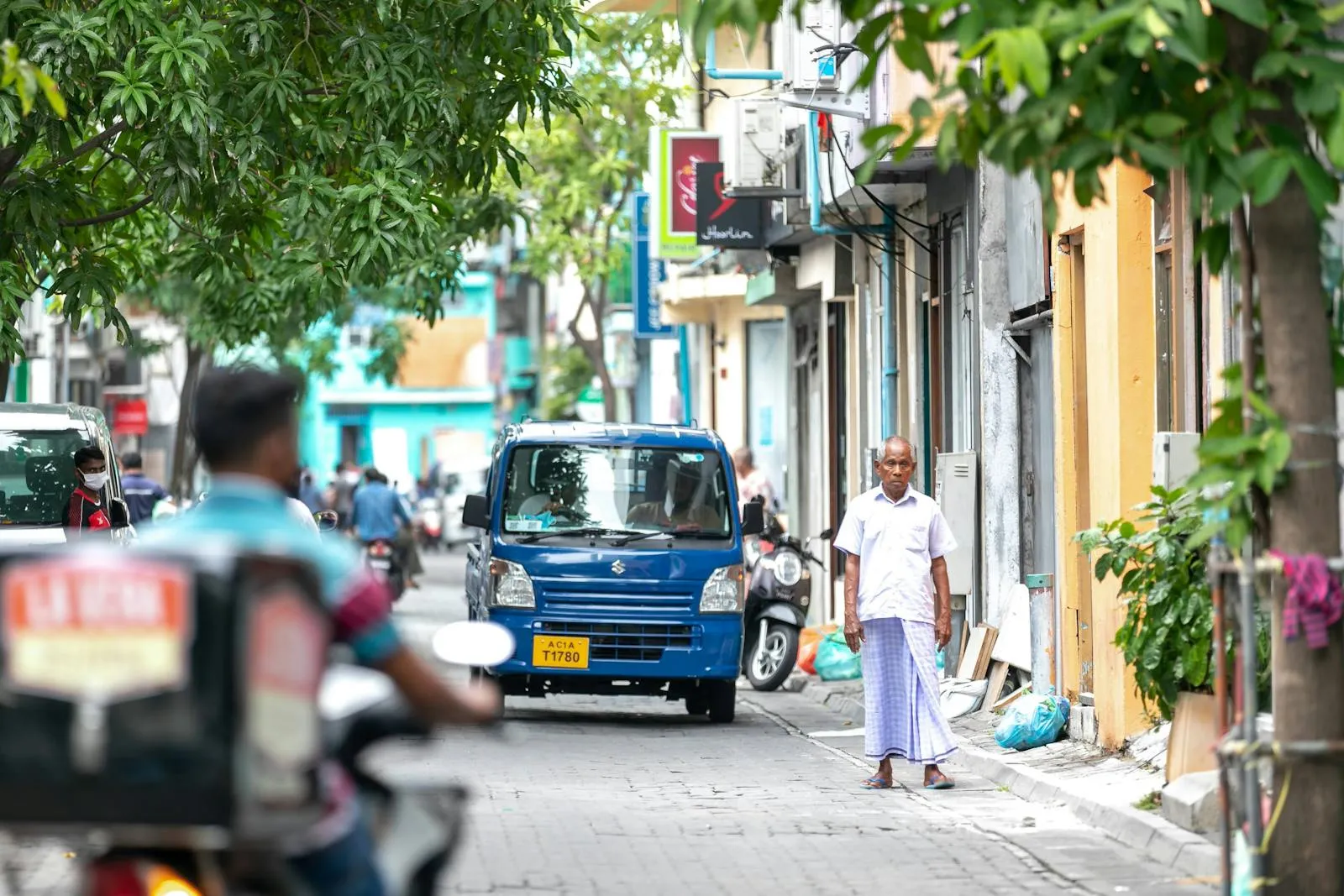
In Male, the extreme density of the population has led to the construction of high-rise apartment buildings, a dramatic departure from the low-rise, compound-style housing of traditional islands. Hulhumale, the planned city on reclaimed land adjacent to Male, features blocks of modern apartments with community facilities. The contrast between the intimate, low-density housing of outer islands and the vertical living of Male illustrates the stark differences in lifestyle across the Maldives.
The Maldivian climate, characterised by high temperatures, intense sunlight, heavy rainfall, high humidity, and the ever-present salt air, has always been the primary determinant of building design. Traditional architecture addressed these challenges with impressive effectiveness: thick coral walls provided thermal mass, thatched roofs were excellent at shedding rain while allowing heat to escape, and the orientation of buildings and openings was calculated to capture the prevailing breeze.
Modern construction has not always been as well adapted to the climate. Concrete and metal, while structurally strong, absorb and radiate heat, making interiors hot and increasing the reliance on air conditioning. The flat roofs common on modern buildings can trap heat and are prone to water pooling during heavy rains. Some architects and builders have begun to reconsider traditional design principles, incorporating natural ventilation, shading, and locally appropriate materials into contemporary designs.
The threat of rising sea levels adds another dimension to housing in the Maldives. With most islands barely a metre above sea level, the vulnerability of homes to flooding, storm surges, and coastal erosion is a constant concern. Building standards have been updated to address these risks, and the reclaimed island of Hulhumale was deliberately built at a higher elevation than natural islands. The challenge of housing a growing population on low-lying, climate-threatened land remains one of the most pressing issues facing the Maldives.
Regardless of whether a Maldivian home is a traditional coral stone compound or a modern concrete apartment, it remains the centre of family life. Maldivian families are typically close-knit, and the home is where meals are shared, children are raised, elders are cared for, and the routines of daily life unfold. Hospitality is a deeply ingrained value, and visitors to a Maldivian home can expect to be offered tea, snacks, and warm conversation.
During festivals and celebrations, the home becomes a hub of activity. The preparation of food for Eid, the decoration of rooms for a wedding, and the gathering of extended family for special occasions all centre on the domestic space. Homes are cleaned, repainted, and beautified in advance of major celebrations, and the open-door policy during Eid means that households receive dozens of visitors over the course of the holiday.
The evolution of the Maldivian home, from coral stone and thatch to concrete and tile, mirrors the broader transformation of Maldivian society. Yet the essential functions of the home, as a place of shelter, family, community, and hospitality, remain constant. Whether sitting on a joali in the shade of a breadfruit tree or in an air-conditioned apartment in Male, Maldivians continue to centre their lives around the warmth of home and the bonds of family and community.